
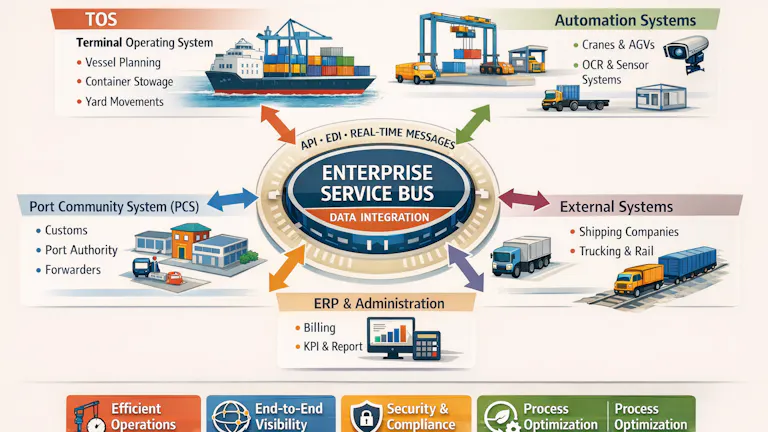
Container terminals are undergoing a profound digital transformation, driven by the need to increase productivity, safety, sustainability and operational resilience. Central to this transformation is the challenge of digital integration and system interoperability, particularly when introducing new automation and AI layers alongside legacy Terminal Operating Systems (TOS), industrial control systems and existing data architectures. This challenge is especially pronounced in brownfield terminals, where automation must be introduced into live operations without disrupting established systems and processes.
This article explores practical lessons from real-world terminal projects carried out by DSP Data and System Planning SA, highlighting the critical role of middleware in enabling smooth integration and operational efficiency.
Interoperability: The Heart of Modern Terminals
A container terminal is a complex ecosystem in which information systems such as TOS, ERP and gate systems coexist with automation technologies, including quay cranes, ASC and AGV or AMR fleets, alongside IoT sensors and advanced AI and analytics platforms.
Interoperability is not merely a technical requirement; it is a key enabler of operational efficiency. Many terminals operate a mosaic of best-of-breed solutions acquired over time, often with proprietary interfaces and inconsistent standards, a typical characteristic of brownfield environments where systems have evolved incrementally. The introduction of AI optimisation, digital twins or predictive maintenance platforms frequently exposes integration gaps, latency issues and data inconsistencies.
Data Integration: Feeding the Digital Engine
AI and automation are only as effective as the data they consume. Container terminals generate data from multiple sources, including TOS, sensors, machines, OCR, GOS and VBS, often in inconsistent or siloed formats.
Technical best practice includes:
- Establishing a unified data layer or data lake
- Defining common data models and a single source of truth
- Implementing data governance and quality management processes
This journey is demanding and requires sustained investment and strong executive sponsorship. However, it can be approached in phases through modular and hybrid architectures.
Standardisation plays a critical role in a global industry. Initiatives such as the Terminal Industry Committee 4.0 (TIC 4.0) contribute significantly to the standardisation of data semantics across the sector.
Membership of the TIC 4.0 association provides access to international institutions such as the UN and ISO, enabling contributors to support policy direction through concrete, hands-on industry knowledge and technical expertise.
TIC 4.0 currently includes 75 members, among them global and regional terminal operators, equipment manufacturers and system vendors, representing over 400 terminals worldwide.
As a TIC 4.0 Ambassador, I strongly believe that participation allows industry players to:
- Contribute to the definition of common data entities
- Align with best practices in data organisation and interoperability
- Collaborate across disciplines, gaining insights that may be overlooked when focusing solely on individual systems or equipment
In this context, it is worth highlighting Business Intelligence solutions such as DSP DATAVIEW. DATAVIEW collects data from multiple sources, including TOS, WMS and GOS. Production systems normalise the data and present transparent KPIs and metrics for live operational monitoring, analytics and forecasting, translating them into TIC 4.0 semantics to ensure shared understanding of data meaning.
Middleware: The Integration Backbone
Beyond the data layer, operations require immediate orchestration of systems to ensure that processes managed by different solutions are seamlessly integrated.
Once the strategic objectives of terminal digitalisation are defined, whether financial, operational or technical, the overall systems architecture should be reviewed to map the responsibilities assigned to each software component. This is the first fundamental step.
There is no single optimal solution. Each business case results in a different architecture, as initial objectives and drivers vary. One consistent lesson from DSP projects is that integration of multiple systems is always required.
Although the TOS remains the operational “brain” of the container terminal, many relevant functionalities remain outside its scope, and it may not be designed to natively interact with highly automated processes, IoT or AI algorithms.
An integration layer, or middleware, enables new optimisation and AI modules to operate as a decision-support layer on top of the TOS without compromising its integrity.
Integration challenges are not limited to equipment, process automation or AI. They are central to almost every operational process. While theThe TOS manages operational data, planning and control, but its interaction with public entities such as customs, port authorities and coast guard bodies, as well as with vehicle booking systems, ERP systems, access control, HR, rostering and logistics stakeholders, including shipping agents, trucking companies, rail operators and freight forwarders, typically relies on integration systems or middleware.
By definition, middleware is process-agnostic and does not make operational decisions. However, the complexity of data exchanges requires domain-expert analysts and software architects to ensure successful and timely implementation.
Why Middleware Matters
- Process-agnostic bridge: Ensures systems speak the same language without taking operational decisions
- Vendor neutrality: Reduces dependency on specific suppliers and supports future integration
- Scalability and modularity: Enables progressive integration of AI, predictive analytics and automation modules
IT-OT Integration and Cybersecurity
Automation and AI require continuous and reliable data exchange between IT and OT systems, including PLCs and industrial controllers.
Cybersecurity is critical in this context. Segregating different system layers, controlling access to sensitive data and protecting both IT and OT networks are essential to prevent potential breaches that could disrupt terminal operations. Cybersecurity must be embedded from the design phase to ensure operational safety and compliance with regulatory standards.
This approach ensures operational safety, cybersecurity, and system certification compliance, while enabling AI and automation to function reliably.
Change Management and Skills Development
Digital integration affects roles, procedures and responsibilities. Successful projects involve:
- IT and OT teams
- Terminal operations personnel
- Maintenance and safety personnel
- Management
Training and development of hybrid IT, OT and data skills is essential to unlock the full potential of automation and AI.
Often, terminals are not structured to manage complex innovation projects. Key individuals responsible for daily operational performance may also be expected to lead transformation initiatives. If they shift into full project mode, short-term operational performance may be affected.
Digitalisation programmes, therefore, require a dedicated team. Organisations must prepare by leveraging internal skills and partnering with experienced consulting firms such as DSP to bring experience and best practices to anticipate risks and reduce project timelines.
The “DSP School of TOS” is the education division created to support knowledge development in systems and emerging technologies. Workshops, classes and academic courses are organised in collaboration with SUPSI University of Lugano.
Conclusion
In the context of container terminals, digital integration and interoperability are the true differentiators between successful automation projects and initiatives and isolated or ineffective projects. Integrating new automation and AI layers with legacy systems is achievable, but it requires a pragmatic, modular and professionally managed approach.
Gradual implementation is essential, particularly in brownfield contexts where operational continuity is non-negotiable. Progressive integrations, tested in simulation or digital twin environments, drastically reduce operational disruptions.
DSP provides simulation and automated testing solutions designed to mitigate risk and reduce the total cost of ownership.
Key Takeaways
- Treat digitalisation as an evolutionary process, not a one-time event
- Deploy progressively
- Involve domain-expert analysts and software architects to manage complex data flows
- Invest in data quality and governance
- Adopt open standards and vendor-neutral approaches
- Use middleware strategically to connect legacy systems, automation, AI and stakeholders without replacing core systems
- Integrate cybersecurity measures from the outset to safeguard operations
- Establish a dedicated professional team
- Align digitalisation with structured change management
Published by Port Technology here: https://www.porttechnology.org/technical-papers/digital-integration-and-interoperability-in-modern-container-terminals/